
Industrial Equipment Cleaning
Chemical De-Scaling of Various Equipments
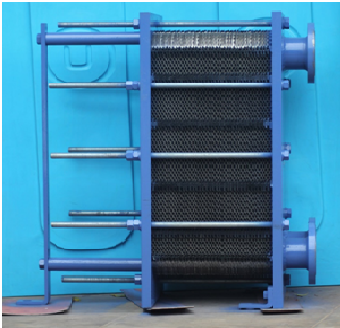
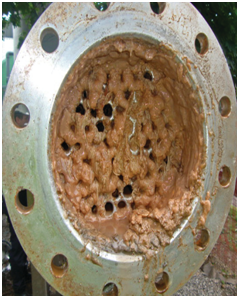
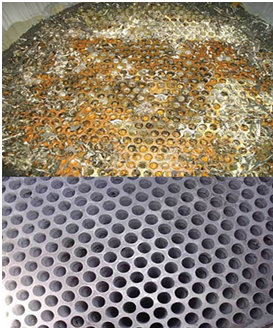
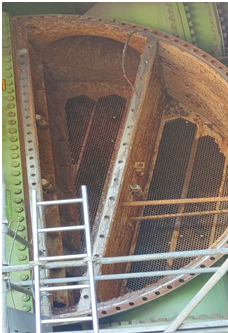
We do chemical descaling for Condenser/heat exchanger/Coolers/Evaporator and Air pre-heater tubes. Chemical cleaning is a good method to use for a fixed channel box design, which is generally more difficult to clean because the tubes cannot be separated from the shell. According to Clean-Co Systems, the process for chemical cleaning can be done in several ways. Chemicals can be circulated through the tubes or cascaded. Some are foam and others liquid. Chemicals will vary depending on the type of exchanger and what it is used for. Conoco Systems explained mild acids are typically used for this type of cleaning. It is beneficial to exchangers that have high amounts of build-up, as chemicals remove more deposit than most alternative cleaning methods.
“Chemicals remove more deposit than most alternative cleaning methods.”
However, there are several downsides to using chemicals, Conoco Systems explained. This method is one of the most expensive ones. Also, chances are, the tubes will have to be mechanically cleaned after the chemicals have done their work to remove any residual substances that could contaminate the next product batch inserted into the tubes. It is also time-consuming and a potential environmental hazard.
Pickling and Passivation
A typical carbon steel pickling job will consist of pre-cleaning, pickling andoiling. The pre-cleaning step is usually done with degreasers or hot caustic solutions. Pickling solutions normally consist of sulphuric and water. The final step in most pickling jobs is the application of a rust inhibitor. Carbon steel cleaning and pickling can also be used as a pre-treatment step prior to painting.
Stainless steel can corrode in service if there is contamination of the surface. Both pickling and passivation are chemical treatments applied to the surface of stainless steel to remove contaminants and assist the formation of a continuous chromium-oxide, passive film. Pickling and passivation are both acid treatments and neither will remove grease or oil. If the fabrication is dirty, it may be necessary to use a detergent or alkaline clean before pickling or passivation.
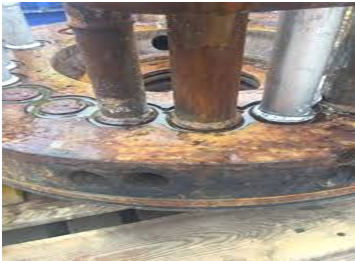
Pickling
Pickling is the removal of any high temperature scale and any adjacent low chromium layer of metal from the surface of stainless steel by chemical means.
Where the steel has been heated by welding, heat treatments or other means, to the point where a coloured oxide layer can be seen, there is a chromium depleted layer on the surface of the steel underneath the oxide layer. The lower chromium content gives lower corrosion resistance. To restore the best corrosion resistant performance, the damaged metal layer must be removed, exposing a fully alloyed stainless-steel surface. Mechanical removal may leave abrasive or other particles embedded (interfering with corrosion performance) or may be impractical, so chemical means are usually employed.
Procedures incorporating pickling solutions of nitric (HNO3) and hydrofluoric (HF) acids remove the scale and the underlying chromium depleted layer and restore the corrosion resistance. Pickling solutions also remove contaminants such as ferrous and ferric oxide particles. Pickling solutions other than mixtures of nitric and hydrofluoric acids exist and can be used for specialised applications.
Pickling pastes, where the solution is mixed with an inert carrier, are commonly used to treat selected areas such as welds.
Pickling involves metal removal and a change or dulling in the visual brightness of the metal.
Electropolishing is a useful alternative to pickling. Metal removal is achieved, but usually results in a bright, smooth and more highly corrosion resistant finish.
Passivation
Passivation is the treatment of the surface of stainless steels, often with acid solutions (or pastes), to remove contaminants and promote the formation of the passive film on a freshly created surface (e.g. through grinding, machining or mechanical damage).
Common passivation treatments include nitric acid (HNO3) solutions or pastes which will clean the steel surface of free iron contaminants. Care must be taken in selecting and using passivation treatments to ensure the selected treatment will target the contaminant. Passivation will also aid in the rapid development of the passive oxide film on the steel’s surface. Passivation does not usually result in a marked change in appearance of the steel surface.
Both pickling and passivation solutions can employ dangerous acids that can damage both the operator and the environment if not handled correctly. Stainless pickling acids are highly corrosive to carbon steel.
It is essential that all acids are thoroughly removed by rinsing the component after completing the process. Residual hydrofluoric acid will initiate pitting corrosion.
It may be advantageous to neutralise the acid with an alkali before the rinsing step.
ASTM A380 Standard Practice for Cleaning, Descaling and Passivation of Stainless-Steel Parts, Equipment and Systems is a valuable source of information on pickling and passivation treatments. Other sources of information may be obtained by contacting ASSDA.
The corrosion resistance of the stainless steel is affected by the roughness of the surface after polishing, with a marked decrease of the corrosion resistance as the surface roughness increases above a Ra value of about 0.5 micrometres. This roughly corresponds to the surface produced by grinding with 320 grit abrasives.
Either passivation or electropolishing can be used to improve the corrosion resistance of mechanically polished surfaces.
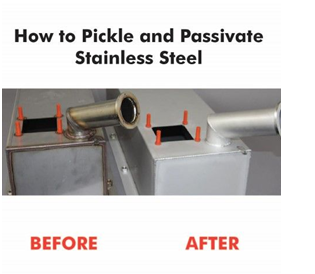
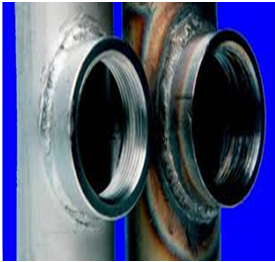
Bullet/Hydrojetting of Tubes & Surface
Hydro-jet cleaning of Tubes &Surface
TRITECH have the experience required to review the particular conditions and employ the appropriate cleaning technique for every application. Our mission is to provide our clients with a level of service that prioritises: Safety, Quality, and a Return on their Investment.
Hydro-jet Systems has developed customised tools for the internal and external descaling and cleaning of condenser/heat exchanger/cooler/boiler/evaporator and APH tubes.
These systems have a high level of safety and productivity with reduced manpower.
Our lancing systems are portable and can be adapted to suit all heat exchangers.
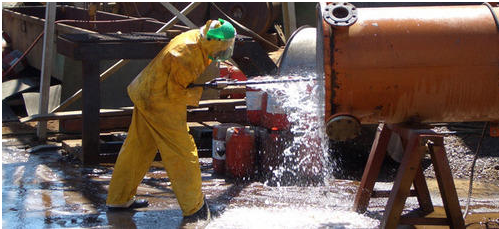
TYPICAL APPLICATIONS OF HYDROBLASTING SERVICES COMMONLY USED FOR THE FOLLOWING:
- Surface Preparation – Metal and Concrete | Paint Removal and Lead Paint Removal | Rust Removal
- Concrete Cleaning | Tank Cleaning | Reactor Cleaning | Boiler Cleaning
- Heat Exchanger Cleaning | Tube Cleaning and Pipe Cleaning | Tube Descaling and Pipe Descaling
- Sewer Jetting | Ship Hull Cleaning | Equipment and Tool Cleaning | Bin and Tote Cleaning
- Evaporators / Ductwork / Drainage Systems / Digesters / Cooling Towers cleaning.
- Coating removal| Weld preparation and mill scale removal | Surface preparation and cleaning
- Refractory removal | Polymer removal | On-line cleaning | Robotic automated cleaning
- Air pre-heaters | Decoking | Boiler de-slagging | Boiler recovery bottoms |Exchangers | Furnaces
- Reactors | Evaporators | Condenser tubes |Water recirculation.
Straight tubes cleaning by Bullet/scraper shot method
Tritech offer this Tube Cleaning Service using this unique Bullet Shot method which is the fastest, most economical, safe & environmentally friendly procedure. Bullet Cleaning “as an effective and efficient method to clean the condenser tubes. Cooling water sources cause different tube fouling problems, affecting the heat transfer and life expectancy of Condensers and Heat Exchangers. We do service in PowerStation’s, Refineries, Petrochemical, cement, fertilizers and other industries in various countries
We will also carry out condenser tube cleaning by bullet shot method service during partial isolation basis(i.e.) one part of the condenser is to be given for cleaning and another part should be in running condition and vice versa.
Technique: Spring loaded tube cleaners (Bullets) are shot through fouled Condenser Tubes using specially designed water guns at 10-15 Kg/cm2 pressure. The bullets moving through the tube from one end to the other in a linear motion scrape off the deposits and corrosion scales. Water from the gun flushes out the scraped deposits resulting in a clean inside surface for the tube, ideal for good heat transfer. Tube cleaners, which exit at the other end of the condenser, are collected, cleaned and used again.
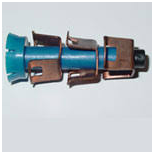
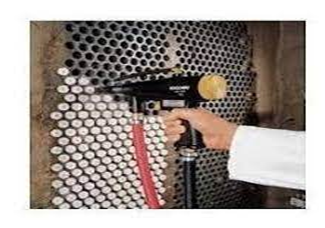
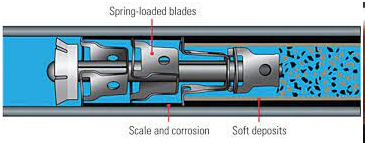
Advantages: This is one of the quickest ways to clean the condenser tubes with the following benefits:
- Big cost saving
- Very limited Shutdown Time
- No damage to tube – hence longer tube life
- Improved plant availability & efficiency
- Low consumption of power & water
- No Environmental pollution
we are extremely well equipped with equipment’s and we will address/attend your emergency cleaning schedule within a very short duration. You can plan your short schedule and inform us and we will keep our resources ready at your location and once the unit goes for shutdown, immediately we can start the job and complete the job quickly.
SEMI- ACID FOAM CLEANING OF FIN TUBES
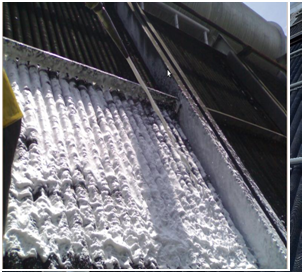
Our technicians use an environmentally friendly chemical foam that saturates and expands into every crevice of the heat exchanger. A low-pressure rinse minimizes overspray and is safer for both personnel and the equipment. The traditional cleaning method (hydro blasting) damages delicate fin fans and compacts the debris into the centre of the tube stack. Our chemical process completely removes dirt, debris and corrosive elements without damaging equipment.
The efficiency of the Air-Cooled equipment’s gets affected over a period of time due to deposition of insects, birds dropping, coke fines, Cement particles, coal dust and other foreign matter and for the efficient working of the coolers, the same have to be removed on a regular basis as they restrict air flow
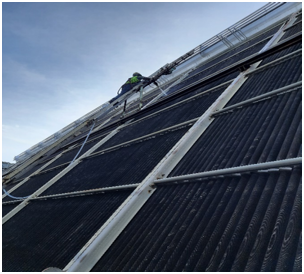
The Foam ridden solvents are allowed to soak for a period of time to permit penetration thereby reducing the adherence of the scale to the surface. Later, the surface is lanced with abundant quantity of water at low pressure to flush out the dislodged scale. In our experience and trial studies, we found that this technique is much suitable for cleaning of the fins where deposits get trapped in inaccessible intricate areas.
Online or Offline Cleaning
Fin Fan Cleaning can be done either Offline during a shutdown or Online during an operational plant by alternating the fans to ensure no downtime. Our Foam Cleaning technology can give you up to 40% increase in air flow.
ADVANTAGES
It has proven to be more efficient and faster than traditional cleaning. Normal water jetting cleaning fragile ling fins, compacts dirt and debris into the centre of the cooling unit, thus significantly reducing cooling efficiency. On the other hand, foam process is a low-pressure cleaning method, which gently soaks away dirt and debris throughout the entire system.
- Bio degradable foam and hence disposal is not an issue.
- No damage to fins as we will be operating at low pressures
- Provides great surface contact and hence better cleaning than other conventional process.
- Very short cleaning time
- Set up time for our equipment is less than four hours.
- Safer for Aluminium as well as Copper Fins.
- Fire water can be used for flushing provided the same is clear.