
Fabrication
VESSELS
All Code Category A and B weld joints, including longitudinal and circumferential joints in vessel shells, heads, and nozzles should be full penetration, double butt welds (Type 1).
Where access limitations require the use of single-welded butt joints, the weld detail should ensure a full penetration weld with a smooth internal surface contour, to obtain radiographs equivalent in quality to double butt welded joints.
An acceptable equivalent for Category A and B joints in nozzles, elbows, and single-sided closure seams, is a single welded butt joint with a gas tungsten arc (GTAW) root bead.
Vessels with a wall thickness of 1/2″ (13 mm) and less may utilize single butt-welded joints, with prior Buyer approval.
- The weld detail employed should ensure a full penetration weld utilizing a single “V” or “U” type weld bevel
- Joints in vessels to be internally coated should utilize double butt welds regardless of thickness, to assure good coating application
All Code Category C and D weld joints, including attachment welds on nozzles, couplings, and manways, should be full penetration welds through the vessel wall, including reinforcing pads where used, and should be welded from both sides.
Where access limitations require the use of single-welded joints, the weld detail should ensure a full penetration weld with a smooth inside surface contour.
Back-up strips should not be used.
Vertical downhill welding should not be permitted.
All semi-automatic or fully-automatic welds should be made utilizing a multi-pass technique.
All non-pressure containing welds, both internal and external, should be full, continuous seal welds.
TANKS
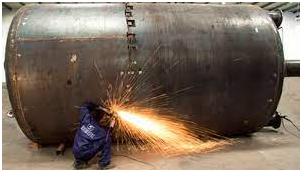
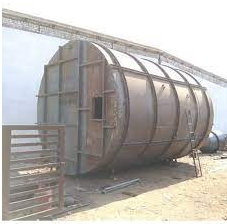
Tritech is your one-stop resource for all your Tank fabrication needs. It includes plate material procurements as per the code requirement.
Tritech owns a mechanical fabrication shop with all the required equipment for plate cutting, rolling, beveling and welding.
We build tanks according to API 650, API 620 and API 12D standards. API has created standards for the design, fabrication and erection of above ground welded steel storage tanks. API utilizes three standards for field erected tanks: API 650, API 620 and API 12D. We specialize in building to these API standards.
PIPELINE
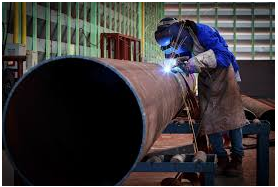
Pipe fabrication can be defined as the process of cutting, bevelling, and welding piping components such as pipes, tees, elbows, flanges, reducers, etc., as dictated by the design documents.
The installation of pipe systems follows its fabrication and is very frequently a part of it. The installation of pipe can be accomplished in the following two primary ways, or combinations thereof:
- Field fabricate and install
- Shop fabricate and field erected
Some contractors prefer to do most, if not all fabrication in the shop, others prefer to set up at the job-site, while others are flexible enough to utilize the best of both methods.
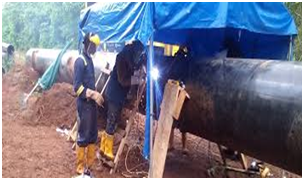
Field fabrication and installation is exactly what it means. The pipe is fabricated on-site, either directly at the place where it is mounted, or in a temporary accommodation in the field.
A number of factors will determine whether it is profitable to fabricate pipe on site:
Type of project, size and scope of the project, pipe size and material, accessibility of the equipment, surface treatment after fabrication, weather conditions, availability of qualified personnel, time available to do the job, etc.
- Only raw material (pipe, fittings, valves, etc.) need to be shipped to the site location. This is much easier to handle and store than multi-plane configurations of pre-fabricated pipe.
- No time-consuming need to carefully crib, tie-down and chock pre-fabricated *spool pieces for transport to the job site.
- Reduced risk of damage to spool pieces.
- More efficient opportunity to fab around unexpected obstacles (structural steel, duct, cable tray, etc.)
- Fabricate-as-you-install reduces the rework risk assumed when pre-fabricating spools, or the cost related to field verification prior to shop fabrication.
The field routing installation of pipe through an array of insufficiently documented locations of existing pipe and equipment, on a retrofit project, is quite frequently more effective than attempting to pre-fabricate pipe based on dimensional assumptions.
Generally speaking, threaded, socket weld, grooved, and other proprietary type joints that do not require buttwelding are field fabricated and installed. Buttwelding of small (bore), NPS 1½ and less, are very often field fabricated and installed because of the added risk of damage during transport, in pre-fabricated form, from the shop to the site.
STRUCTURE
Structural steelwork is generally used to form a the ‘skeleton’ frame of a building or other built asset, typically consisting of columns and beams which are riveted, bolted or welded together. There are a number of different forms of structural steelwork.
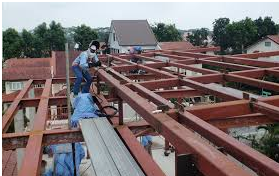
The process of steel fabrication involves grinding, welding, cutting, bending, drilling, punching, burning or melting and other general crafting methods using various high quality tools and CNC equipment. The entire steel fabrication process is systematic and requires utmost planning, precision, and knowledge. Steel fabricators are well aware of all the crucial steps and measures that need to be taken care of in the fabrication process. Structural steel is usually fabricated to create structures like beams, trusses, hollow sections, angles and plates.
These steel members must be accurately fabricated before assembling them together. All component parts of these members are fitted-up temporarily with rivets, bolts, or small amounts of welds. Various fastening methods are employed to deliver different types of finishes. Finishing is generally performed by milling, sawing or other suitable methods.